< Liber Primus
Chapter 1
Refinding the Soul
Ascending |
Awareness
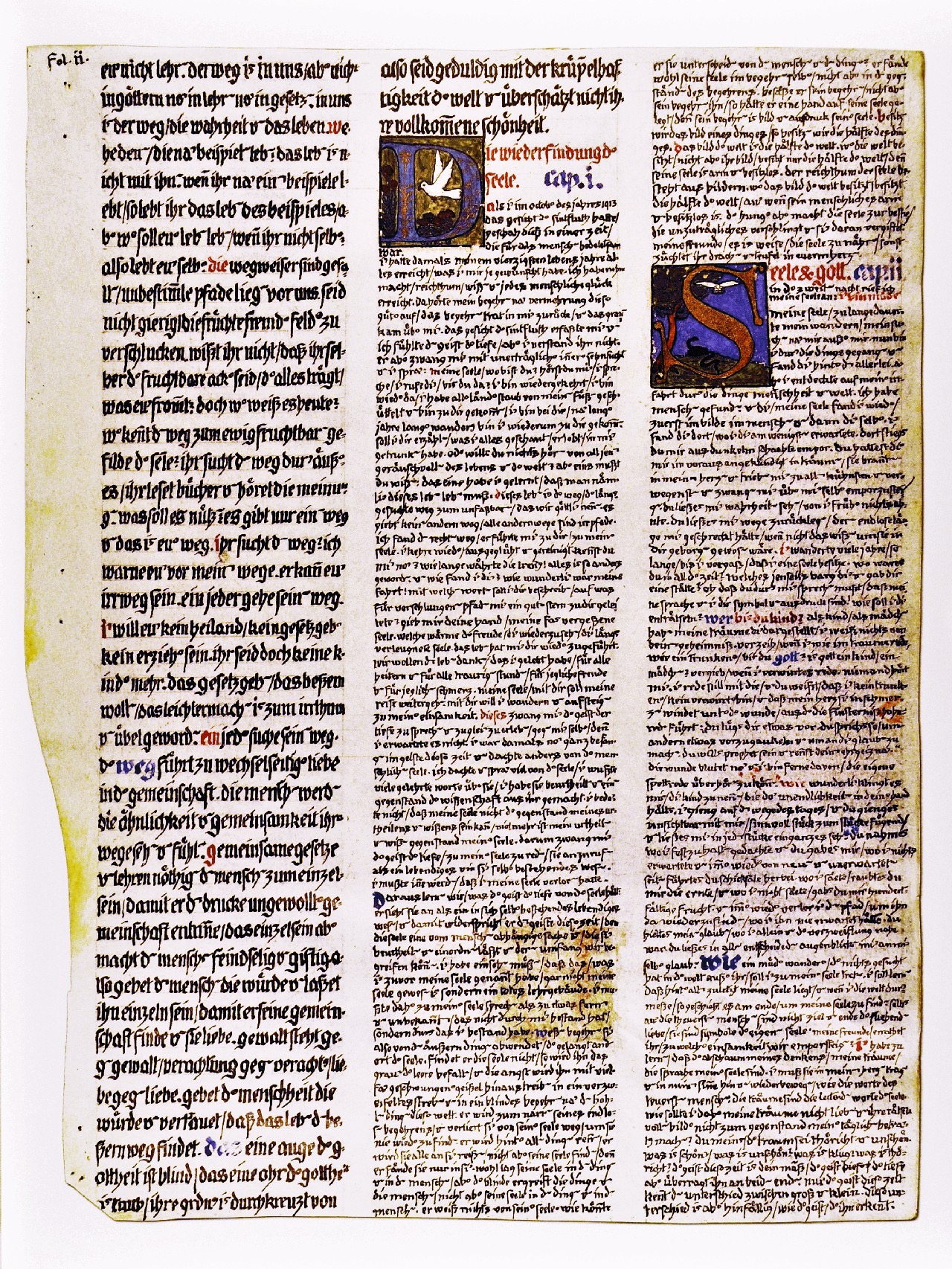
Ascending
HI ii(r)30
cap. i.31
[2]
When I had the vision of the flood in October of the year 1913, it happened at a time
that was significant for me as a man. At that time, in the fortieth year of my life, I
had achieved everything that I had wished for myself. I had achieved honor, power,
wealth, knowledge, and every human happiness. Then my desire for the increase of these
trappings ceased, the desire ebbed from me and horror came over me.32The vision of the flood seized me and I felt the spirit of the
depths, but I did not understand him.33 Yet he drove
me on with unbearable inner longing and I said:
[I]34
my soul, where are you?
do you hear me?
i speak, i call you--
are you there?
i have returned.
i am here again.
i have shaken the dust of all the lands from my feet,
and i have come to you,
i am with you.
after long years of long wandering,
i have come to you again.
should I tell you everything
i have seen,
experienced,
and drunk in?
or do you not want to hear about
all the noise
of life and the world?
but one thing you must know:
the one thing i have learned
is that one must live this life.
this life is the way
the long sought-after way
to the unfathomable,
which we call divine.35
there is no other way,
all other ways are false paths.
i found the right way,
it led me to you,
to my soul.
i return,
tempered and purified.
do you still know me?
how long the separation lasted!
everything has become so different.
and how did I find you?
how strange my journey was!
what words should I use
to tell you
on what twisted paths
a good star has guided me to you?
give me your hand,
my almost forgotten soul.
how warm the joy at seeing you again,
you long disavowed soul.
life has led me back to you.
let us thank the life i have lived
for all the happy
and all the sad hours,
for every joy
for every sadness.
my soul,
my journey should continue with you.
i will wander with you
and ascend to my solitude.36
Awareness
[2]
The spirit of the depths forced me to say this and at the same time to undergo it
against myself, since I had not expected it then. I still labored misguidedly under
the spirit of this time, and thought differently about the human soul. I thought and
spoke much of the soul. I knew many learned words for her, I had judged her and turned
her into a scientific object.37 I did not consider that
my soul cannot be the object of my judgment and knowledge; much more are my judgment and
knowledge the objects of my soul.38 Therefore
the spirit of the depths forced me to speak to my soul, to call upon her as a
living and self-existing being. I had to become aware that I had lost my
soul.
From this we learn how the spirit of the depths considers the soul: he sees her as a
living and self-existing being, and with this he contradicts the spirit of this
time, for whom the soul is a thing dependent on man, which lets herself be judged and
arranged, and whose circumference we can grasp. I had to accept that what I had previously
called my soul was not at all my soul, but a dead system.39 Hence I had to speak to my soul as to something far off and
unknown, which did not exist through me, but
through whom I existed.
He whose desire turns away from outer things, reaches the place of the
soul.40 If he does not find the soul, the
horror of emptiness will overcome him, and fear will drive him with a whip lashing time
and again in a desperate endeavor and a blind desire for the hollow things of the
world. He becomes a fool through his endless desire, and forgets the way of
his soul, never to find her again. He will run after all things, and will seize hold of
them, but he will not find his soul, since
he would find her only in himself. Truly his soul lies in things and men, but
the blind one seizes things and men, yet not his soul in
things and men. He has no knowledge of his soul. How could he tell her apart from
things and men? He could find his soul in desire itself but
not in the objects of desire. If he possessed his desire, and his desire did not
possess him, he would lay a hand on his soul, since his desire is the image and
expression of his soul.41
If we possess the image of a thing, we possess half the thing.
The image of the world is half the world. He who possesses the world but
not its image possesses only half the world, since his soul is poor and has
nothing. The wealth of the soul exists in images.42 He who possesses the image of the world, possesses half the world,
even if his humanity is poor and owns nothing.43
But hunger makes the soul into a beast that devours the unbearable and is poisoned by it. My
friends, it is wise to nourish the soul, otherwise you will breed dragons and
devils in your heart.44
-
32
The Handwritten Draft has: "Dear Friends!" (p. 1). The Draft
has "Dear Friends!" (p. 1). In his lecture at the ETH on June 14, 1935, Jung noted:
"A point exists at about the thirty-fifth year when things begin to change, it is
the first moment of the shadow side of life, of the going down to death. It is clear
that Dante found this point and those who have read Zarathustra will know that
Nietzsche also discovered it. When this mining point comes people meet it in several
ways: some turn away from it, others plunge into it; and something important
happens to yet others from the outside. If we do not see a thing Fate does it to us"
(Barbara Hannah, ed., Modern Psychology Vol. 1 and 2: Notes on Lectures given at the
Eirlgenéssiche TechniSche Hocbschule, Zürich, by Prof Dr. C. G. Jung, October
1933-july 1935, 2nd ed. [Zürich: privately printed, 1959], p. 223).
-
33
On October 27, 1913, Jung wrote to Freud breaking off relations with him and
resigning as editor of the ]al11'bucfaf£ir Psychaanalytische und Fsychopathologiscbe
Forscliungen (William McGuire, ed., The Freud/jung Letters, tr. R. Mannheim and
R.F.C. Hull [Princeton: Princeton University Press/Bollingen Series, 1974], p. SSO)
-
34
November 12, 1913. After "longing" the Draft has "at the beginning of the following
month, I seized my pen and began writing this" (p. 13).
-
35
This affirmation occurs a number of times in Jung's later writings-see for
example, lane Fratt, "Notes on a talk given by C. G. lung: 'Is analytical psychology
a religion?'" Spring Journal of Archetypal Psychology and Jungian Thought (1972), p.
148.
-
36
Jung later described his personal transformation at this time as an example of the
beginning of the second half of life, which frequently marked a return to the soul,
after the goals and ambitions of the first half of life had been achieved (Symbols
of Transformation [1952], CW 5, p. xvi); see also "The turning point of life" (1930,
CW 8).
-
37
Jung is referring here to his earlier work. For example, he had written in 1905,
"Through the associations experiment we are at least given the means to pave the way
for the experimental research of the mysteries of the.Sick soul" ("The
psychopathological meaning of the associations experiment," CW 2, §897).
-
38
In Psychological Types (1921) Jung noted that in psychology conceptions are "a
product of the subjective psychological constellation of the researcher" (CW 6, §9).
This reflexivity formed an important theme in his later work (see myjung and the
Making of Modern Psychology: The Dream of a Science, iI).
-
39
The Draft continues: a dead system that I had contrived assembled from so-called
experiences and judgments (p. 16).
-
40
In 1913, Jung called this process the introversion of the libido ("On the
question of psychological types," CW 6).
-
41
In 1912, Jung had written, "It is a common error to judge longing in terms of the
quality of the object... Nature is only beautiful on account of the longing and love
accorded to it by man, the aesthetic attributes emanating therefrom apply first and
foremost to the libido, which alone accounts for the beauty of nature"
(Transformations and Symbols of the Libido,CW B, §147).
-
42
In Psychological Types, Jung articulated this primacy of the image through his
notion of esse in anima (cw 6, §66f:f §711ff). In her diary notes, Cary
Baynes commented on this passage: "What struck me especially was what you said about
the "Bild" [image] being half the world. That is the thing that makes humanity so
dull. They have missed understanding that thing. The world, that is the thing that
holds them rapt. 'Das Bild', they have never seriously considered unless they have
been poets" (February 8, 1924, CAB).
-
43
The Draft continues: "He who strives only for things will sink into poverty as
outer wealth increases, and his soul will be afflicted by protracted illness"
(p. 17).
-
44
The Draft continues: "This parable about refinding the soul, my friends, is meant to
show you that you have only seen me as half a man, since my soul had lost me. I am
certain that you did not notice this, because how many are with their soul today?
Yet without the soul, there is no path that leads beyond these times" (p. 17). In
her diary notes Cary Baynes commented on this passage: "February 8th [1924]. I came
to your conversation with your soul. All that you say is said in the right way and
is sincere. It is no cry of the young man awakening into life but that of the mature
man who has lived fully and richly in ways of the world and yet knows almost
abruptly one night, say, that he has missed the essence. The vision came at the
height of your power, when you could have gone on just as you were with perfect
worldly success. I do not know how you were strong enough to give it heed. I am
really for everything you say and understand it. Everyone who has lost the
connection with his soul or has known how to give it life ought to have a chance to
see this book. Every word so far lives for me and strengthens in just where I feel
weak, but as you say the world is very far away from it in mood today. That does not
matter too much, a book can swing even a whole world if it is written in fire and
blood" (CFB).
< Liber Primus